How to Buy Property in Nigeria While Working Full-Time in Canada (Complete Guide)
Working in Toronto, Vancouver, or Calgary and want to buy property in Nigeria? Here's your step-by-step guide to investing remotely without getting scammed.
It's 11 PM in Toronto. You just finished your shift, and instead of Netflix, you're scrolling through property listings in Lagos on your phone.
You've been in Canada for 6 years now. Good job, permanent residency, maybe even citizenship on the horizon. But here's the thing: your salary goes further in Nigeria than it ever will in Toronto.
That $65,000 CAD you're earning? In Nigeria, it could buy you a 3-bedroom duplex in a developing area. Or a plot of land in Lekki. Or a rental property generating monthly income.
But you're 9,000 kilometers away, 6 hours ahead in time zones, and every horror story about Nigerian real estate scams is playing in your head.
Can you really buy property in Nigeria while working full-time in Canada? Without getting scammed? Without flying back and forth every week?
The answer is yes. Thousands of Canadians of Nigerian descent do it every year. But you need to do it right.
Let me show you exactly how.
Why Nigerian-Canadians Are Investing Back Home
Before we get into the how, let's talk about the why—because understanding your goals shapes your strategy.
Reason 1: Your Canadian Dollars Go 10× Further
You're making $60,000-$100,000 CAD in Canada. That's comfortable, but:
- Houses in Toronto average $1.1 million CAD
- Vancouver is even worse at $1.2 million CAD
- Condos in decent areas start at $600,000 CAD
Meanwhile, in Nigeria:
- A 3-bedroom duplex in Lekki: ₦40-60 million ($25,000-$37,000 CAD)
- A 500 sqm plot of land in a developing area: ₦8-15 million ($5,000-$9,500 CAD)
- A 2-bedroom apartment for rentals: ₦15-25 million ($9,500-$15,700 CAD)
Same amount of savings, completely different purchasing power.
Reason 2: Rental Income in CAD
That 2-bedroom apartment in Ajah generating ₦1.5 million annually in rent? That's about $950 CAD per year.
Doesn't sound like much until you realize you bought it for $12,000 CAD. That's an 8% annual yield before appreciation.
Try getting that in a Toronto GIC.
Some Nigerian-Canadians are building portfolios of 3-5 rental properties generating $3,000-$5,000 CAD annually in passive income.
Reason 3: Building a Retirement Home (While You're Young)
You're 35, living in Calgary. You plan to work until 60, then maybe split time between Canada and Nigeria.
Starting your Nigerian property investment now means:
- Your house is built and paid off by retirement
- Property has appreciated 2-3× by the time you retire
- You have roots and a base when you visit family
Waiting until retirement to start means building in your 60s. Starting now means enjoying it in your 60s.
Reason 4: Wealth You Can Pass Down
Canadian taxes will eat into your estate. But property in Nigeria, transferred to your children, becomes generational wealth.
Many Nigerian-Canadians are building not just for themselves, but for their kids—a property empire back home that provides options and security.
The Challenges of Buying from Canada (Let's Be Real)
I'm not going to sugarcoat it. Buying Nigerian property from Canada has real challenges:
Challenge 1: Time Zone Difference
Nigeria is 6 hours ahead of Eastern Canada (Toronto), 9 hours ahead of Western Canada (Vancouver).
When you're free (evenings after work), Nigeria is sleeping. When Nigeria's business hours start (8 AM WAT), you're still asleep or just starting your workday.
Coordinating calls, document reviews, and site inspections requires intentional scheduling.
Challenge 2: Currency Exchange Volatility
You're earning in CAD. Buying in naira. The exchange rate fluctuates constantly.
In 2020, $1 CAD = ₦280. In 2023, $1 CAD = ₦570. In 2025, $1 CAD = ₦1,250-1,300 (approx).
This volatility affects:
- Your budget (the property price in naira might stay same, but costs you more or less CAD depending on timing)
- Your transfer costs (banks charge 2-4% on international transfers)
- Your rental income (converting naira rent back to CAD gives you less when naira weakens)
Challenge 3: Can't Physically Inspect Properties
In Toronto, you'd never buy a house without seeing it. But flying to Nigeria every time you want to view a property? That's $1,500-$2,500 CAD per trip.
You're relying on photos, videos, and representatives. That's risky if you don't have trustworthy people on the ground.
Challenge 4: Legal and Bureaucratic Complexity
Nigerian land law is complex. And doing it remotely adds layers:
- Signing documents via Power of Attorney
- Verifying titles from 9,000 km away
- Navigating Governor's Consent processes
- Handling property taxes and fees
One wrong move and your $30,000 CAD is gone.
Challenge 5: Scammers Target Diaspora
You're the perfect mark for scammers:
- You have foreign currency (assumed to be "rich")
- You're not physically present (can't verify claims easily)
- You might not know current Nigerian real estate practices
- You're emotional about "investing back home" (clouds judgment)
Scammers know this. They craft convincing pitches, fake documents, and elaborate schemes specifically for diaspora investors.
But here's the thing: challenges don't mean impossible. They just mean you need a system.
The Step-by-Step System for Buying from Canada
Here's the exact process I recommend for Nigerian-Canadians buying property back home.
Step 1: Define Your Investment Goal (Before You Browse Listings)
Don't start by looking at properties. Start by clarifying what you want:
Option A: Rental Income Property
- Buy a 2-3 bedroom apartment in a rental-heavy area
- Furnish it and lease to tenants
- Generate annual rental income in naira (convert to CAD as needed)
- Best for: Investors wanting cash flow
Option B: Land Banking
- Buy a plot of land in a developing area
- Hold for 5-10 years as the area appreciates
- Sell at 3-5× the purchase price
- Best for: Long-term wealth building, lower management needs
Option C: Build Your Retirement/Family Home
- Buy land, build a house over 1-3 years
- Use it when visiting, or lease it until you retire
- Best for: People planning to spend significant time in Nigeria eventually
Option D: Flip/Development
- Buy land or distressed property
- Develop and sell quickly
- Best for: High-risk, high-reward investors with local partners
Knowing your goal determines your location, budget, and strategy.
Step 2: Set Your Budget in CAD (And Stick to It)
Decide how much you can allocate. Be realistic:
Starter Budget: $8,000 - $15,000 CAD
- Buys a plot of land in developing areas (Epe, Ibeju-Lekki outskirts, Mowe, Ibafo)
- Or a small apartment in secondary locations
Mid-Range Budget: $20,000 - $40,000 CAD
- Buys land in better locations (Ajah, Sangotedo, parts of Lekki)
- Or a 2-bedroom apartment for rentals
Premium Budget: $50,000 - $100,000+ CAD
- Buys land in prime areas (Lekki Phase 1, Ikoyi, VGC)
- Or builds a 3-4 bedroom duplex
Don't forget to budget for:
- Legal fees (5-10% of purchase price)
- Agent fees (5-10%)
- Survey and verification costs ($500-$1,000 CAD)
- Governor's Consent fee (15% in Lagos)
- Transfer fees ($500-$1,500 CAD)
If your budget is $25,000 CAD, plan to spend only $20,000 on the property itself. The other $5,000 goes to transaction costs.
Step 3: Build Your Nigeria-Based Team
You can't do this alone from Calgary. You need boots on the ground.
Your Essential Team:
1. Property Lawyer (Non-Negotiable)
- Verifies documents
- Conducts land searches
- Handles Governor's Consent application
- Holds funds in escrow
- Protects you legally
Cost: ₦300,000 - ₦1 million ($230-$770 CAD) depending on transaction complexity
How to find: Ask for referrals from other Nigerian-Canadians, check Nigerian Bar Association directory, interview 2-3 via Zoom before choosing.
2. Real Estate Agent (Preferably Someone You Trust)
- Shows you properties via video call
- Negotiates on your behalf
- Coordinates inspections
- Knows the local market
Cost: Usually 5-10% commission (paid by seller or split)
How to find: Referrals from family/friends in Nigeria, established agencies with diaspora experience, online reviews.
3. Surveyor (For Physical Verification)
- Physically inspects the land
- Verifies boundaries and size
- Checks for encroachments
- Provides measurement report
Cost: ₦150,000 - ₦500,000 ($120-$385 CAD)
4. Property Inspector/Project Manager (Optional but Recommended)
- Your eyes on the ground
- Takes photos/videos of properties
- Verifies what the agent shows you is accurate
- Can oversee construction if you're building
Cost: ₦50,000 - ₦200,000 per inspection ($40-$155 CAD)
Pro tip: If you have family in Nigeria, involve them—but also verify independently. Family can be incredibly helpful or incredibly problematic in real estate. Trust, but verify.
Step 4: Research and Shortlist Properties (Remotely)
Now you can start browsing. But do it smart.
Best Platforms for Nigerian Property Listings:
- Nigeria Property Centre (nigeriapropertycentre.com)
- PropertyPro.ng
- Private Property Nigeria
- Lamudi Nigeria
- Jiji (more grassroots listings)
What to look for:
- Properties with detailed photos (10+ images minimum)
- Clear description of title documents (C of O mentioned)
- Verified listings (platforms mark verified agents)
- Properties within your budget INCLUDING transaction costs
- Locations with good infrastructure (roads, electricity, water)
Create a shortlist of 5-8 properties.
Step 5: Virtual Inspection via Video Call
Don't rely on photos alone. They can be Photoshopped, outdated, or misleading.
Request LIVE video tours:
Schedule a WhatsApp or Zoom video call with the agent.
Ask them to:
- Show you the property in real-time (not recorded video)
- Walk the perimeter if it's land
- Show neighboring properties
- Show the street and access road
- Answer your questions live
During the tour, ask:
- What's the noise level like?
- How's the road access during rainy season?
- Are there any ongoing disputes with neighbors?
- What's the power situation (NEPA hours per day)?
- Where's the nearest hospital, school, market?
Record the video call (with permission) for your records.
Red flag: Agent refuses live video and only sends pre-recorded content.
Step 6: Document Verification (Don't Skip This)
Never, ever wire money before verifying documents.
Send the following documents to your lawyer:
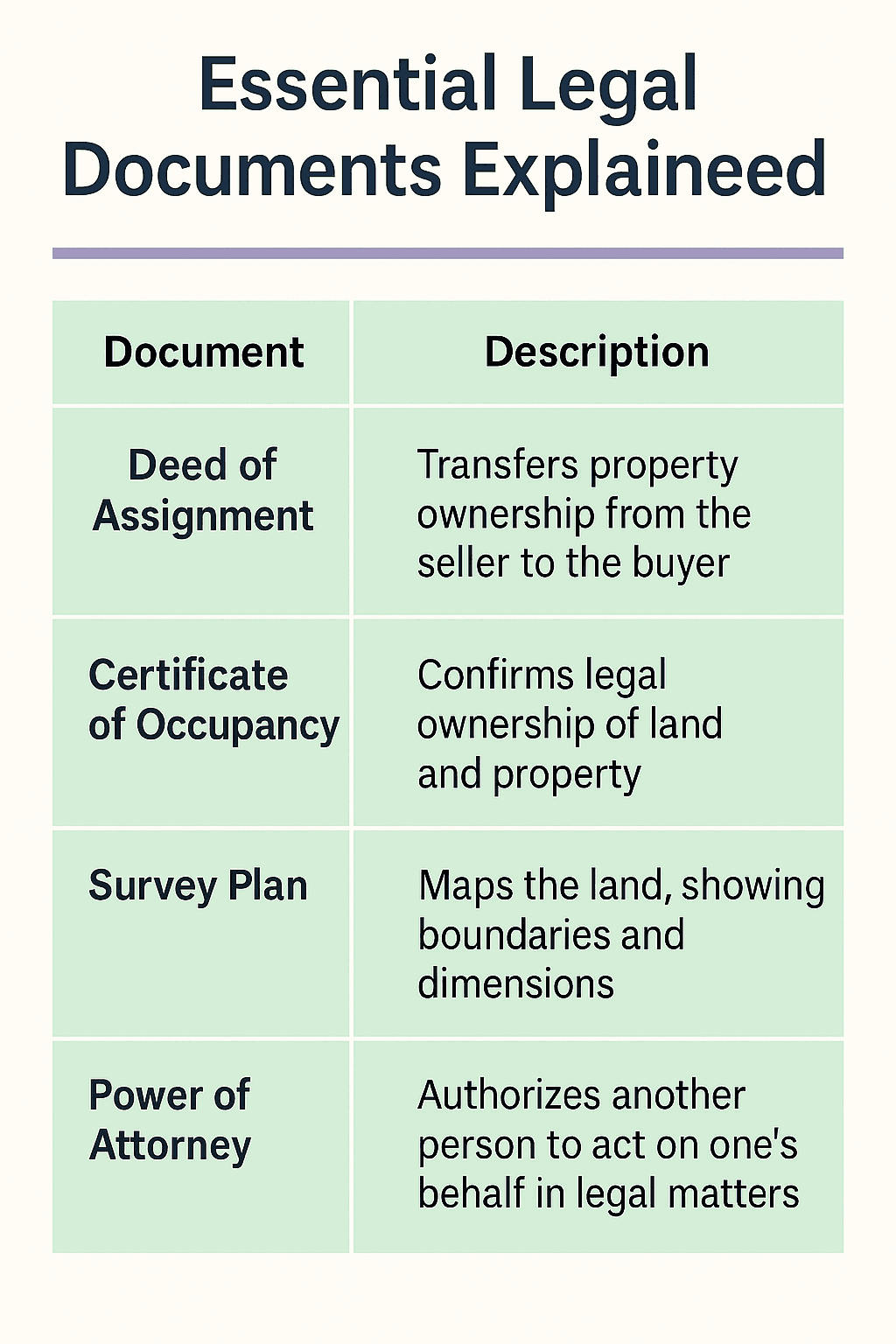
- Certificate of Occupancy (C of O)
- Survey Plan
- Deed of Assignment (if applicable)
- Governor's Consent (if applicable)
- Receipts from the Land Registry
Your lawyer will:
- Conduct a land search at the state land registry
- Verify the C of O is legitimate and registered
- Check if there are liens, caveats, or disputes on the property
- Confirm the seller is the rightful owner
- Verify the land isn't under government acquisition
This costs $500-$1,000 CAD but is non-negotiable.
Read our full guide on document verification.
Step 7: Negotiate Price (Yes, from Canada)
Nigerian real estate is highly negotiable. The listed price is almost never the final price.
Negotiation tactics:
- Research comparable properties in the area (use your agent)
- Point out any issues (bad road access, no C of O, needs repairs)
- Offer 10-20% below asking price as your opening bid
- Be willing to walk away (the best negotiating leverage)
Since you're in Canada, your agent or lawyer can negotiate on your behalf. Give them a maximum price you're willing to pay and let them work.
Example:
- Listed price: ₦25 million
- You offer: ₦20 million
- Seller counters: ₦23 million
- You counter: ₦21.5 million
- Agreed: ₦22 million
You just saved ₦3 million ($2,300 CAD) with a few phone calls.
Step 8: Use Escrow for Payment (Protect Your Money)
NEVER wire money directly to the seller. Use a lawyer's escrow account.
How Escrow Works:
- You and seller agree on price and terms
- You wire funds to your lawyer's escrow account (a special trust account for holding client money)
- Lawyer verifies all documents are in order
- Lawyer confirms the transaction is legitimate
- ONLY THEN does the lawyer release funds to the seller
- Lawyer facilitates the transfer of title to you
This protects you because:
- If documents are fake, lawyer doesn't release funds
- If seller backs out, you get your money back
- Lawyer is professionally liable if they mishandle your funds
How to send money from Canada to Nigeria:
Option A: Bank Wire Transfer
- Most secure
- Costs: 2-4% in fees + exchange rate markup
- Timeline: 3-5 business days
Option B: Specialist Transfer Services
- Wise (formerly TransferWise)
- RemitBee (Canada-specific, often better rates than banks)
- WorldRemit
These often have lower fees than banks (1-2%) and better exchange rates.
Never use:
- Western Union or MoneyGram for large property transactions (too risky)
- Cash (invites fraud and leaves no paper trail)
- Direct transfers to individuals (always use lawyer's escrow)
Step 9: Execute the Sale Documents (Via Power of Attorney)
You're in Canada. The sale is happening in Nigeria. You can't sign documents in person.
Solution: Power of Attorney (POA).
How it Works:
- Your lawyer drafts a Power of Attorney document
- You sign it in Canada in front of a Canadian notary public
- The POA is authenticated/apostilled (certified for international use)
- The POA is sent to Nigeria
- Your lawyer (or designated representative) signs documents on your behalf
What the POA allows:
- Signing the Deed of Assignment
- Completing the land transfer
- Applying for Governor's Consent
- Registering the property in your name
Important: Make the POA specific (limited to this one transaction) not general (which gives broad powers and is risky).
Cost of notarization/apostille in Canada: $100-$300 CAD.
Step 10: Apply for Governor's Consent
After the sale completes, you must apply for Governor's Consent to legalize the transfer.
Your lawyer handles this, but you need to:
- Pay the consent fee (15% of property value in Lagos)
- Provide tax clearance certificates
- Submit required documents
Timeline: 6-12 months (sometimes longer)
Cost: 15% of property value + lawyer's processing fee
Read our detailed guide on Governor's Consent.
Step 11: Secure the Property
Once the sale is done, protect your investment:
If it's land:
- Fence the perimeter immediately (₦200,000-₦500,000)
- Hire a security guard or caretaker (₦40,000-₦60,000/month)
- Put up signage with your lawyer's contact info
- Visit (or have someone visit) regularly to check for encroachment
If it's a building:
- Change all locks
- Install basic security (cameras if budget allows)
- Hire a property manager if you're renting it out
- Ensure utilities are connected and paid
Step 12: Manage Remotely (Ongoing)
If you're generating rental income or building:
Hire a Property Manager (₦50,000-₦150,000/month or 10% of rent)
- Finds tenants
- Collects rent
- Handles maintenance
- Sends you monthly reports and photos
Set up remote monitoring:
- CCTV cameras you can view from Canada via phone app
- Regular video calls with your property manager
- Quarterly inspections by a trusted person
- Bank account in Nigeria for receiving rent (then transfer to Canada periodically)
Specific Tips for Canadian Buyers
Tax Considerations
In Nigeria:
- You'll pay property tax annually (varies by state, usually minimal)
- You'll pay income tax on rental income in Nigeria (file with FIRS)
In Canada:
- You must declare foreign property worth over $100,000 CAD on your T1135 form
- Rental income from Nigeria is taxable in Canada (but you get credit for taxes paid in Nigeria to avoid double taxation)
Consult a Canadian accountant familiar with international property to ensure compliance.
Currency Management
Strategy 1: Buy When CAD Is Strong Monitor CAD/NGN exchange rates. When CAD strengthens, that's your buying window.
Strategy 2: Lock In Exchange Rates Some currency services offer rate locks if you're planning a purchase in 30-60 days.
Strategy 3: Keep Rental Income in Naira If you're collecting rent, consider leaving it in a Nigerian account to:
- Avoid conversion fees on small amounts
- Use for property maintenance
- Build up for future Nigerian investments
Only convert to CAD when you actually need it or when rates are favorable.
Visiting Your Property
Plan to visit Nigeria at least once during the buying process (ideally) and once every 1-2 years after purchase.
When to visit:
- During final document signing (if you don't use POA)
- When construction starts (if building)
- When construction completes
- To check on rental property condition
Book your trip during less busy times (avoid December's high ticket prices).
Biggest Mistakes Nigerian-Canadians Make
Learn from others' errors:
Mistake 1: Trusting Family Blindly
"My cousin will handle it" turns into "My cousin bought land in his own name" or "My cousin pocketed half the construction budget."
Family can help, but verify independently. Use lawyers. Get receipts. Check documents.
Mistake 2: Buying in Areas They Remember from 20 Years Ago
"I grew up in Mushin, so I'll buy there."
But Mushin hasn't appreciated much. Meanwhile, Lekki exploded.
Buy based on current market dynamics, not nostalgia.
Mistake 3: Underestimating Costs
"The land is $20,000, I have $20,000, I'm good!"
Then you discover:
- Legal fees: $1,500
- Governor's consent: $3,000
- Fencing: $400
- Agent fee: $2,000
You're $7,000 short.
Budget 30-40% above the property price for total transaction costs.
Mistake 4: Buying Without Visiting (Ever)
Some people buy purely remotely and never see the property in person.
That works sometimes. But you're risking discovering issues later.
If possible, visit before buying or within 6 months after purchase.
Mistake 5: Ignoring Infrastructure
"The price is great!"
But there's no road access. No electricity. No water. And it'll cost you $10,000 to fix.
Cheap land in undeveloped areas might cost more long-term than expensive land in developed areas.
Should You Use a Real Estate Company or Go Independent?
Independent Route (Using Agents and Lawyers):
Pros:
- Potentially lower costs
- More control over the process
- Wider selection of properties
Cons:
- You coordinate everything yourself
- Higher risk of fraud
- More time-intensive
Real Estate Company (Like Holford Homes):
Pros:
- Pre-verified properties with clear title
- One point of contact for everything
- Streamlined process for diaspora buyers
- Legal and technical teams already in place
- Ongoing property management services
Cons:
- Potentially higher property prices (due to company overhead)
- Limited to their inventory
My recommendation: If it's your first Nigerian property purchase, use an established company. The peace of mind and reduced fraud risk are worth it.
Once you have experience, you can venture into independent purchases.
Explore our diaspora-focused properties or book a free consultation.
Your Timeline: How Long Does This Actually Take?
From decision to owning property:
- Week 1-2: Define goals, set budget, assemble team (lawyer, agent)
- Week 3-6: Research properties, virtual tours, shortlist
- Week 7-8: Document verification, due diligence
- Week 9-10: Negotiation, agreement
- Week 11: Payment via escrow, sale execution
- Week 12: POA processing (if needed)
- Month 4-12: Governor's Consent processing
Total: 3-12 months from start to legally owning property.
Building takes longer (6-18 months depending on size).
Final Thoughts: You Can Do This
Yes, you're 9,000 km away. Yes, the time zones are annoying. Yes, there are risks.
But thousands of Nigerian-Canadians are successfully building wealth through Nigerian real estate every single year.
You're earning in one of the world's strongest currencies. Nigerian property—bought smart—can grow your wealth faster than most Canadian investments.
Just don't rush. Don't skip steps. Don't trust blindly.
Verify. Use professionals. Protect your money.
Your future self—sitting in that Lagos home during Christmas, or collecting rental income, or passing wealth to your kids—will thank you.
Start today. Define your goal. Set your budget. Build your team.
Your Nigerian property journey begins with one decision: "I'm doing this right."
Are you a Nigerian-Canadian who's bought property back home? What was your experience? Share in the comments or join our diaspora investor community.
Questions about buying from Canada? Book a free consultation and let's discuss your specific situation.