How to Finance Your Nigerian Property Purchase from the US (Without Breaking the Bank)

Buying Nigerian property while living in America? Here are your financing options, money transfer strategies, and how to maximize your dollars.
You're sitting in your Atlanta apartment, staring at your bank account.
You've been saving for two years. $28,000 sitting there. Enough for a down payment on... absolutely nothing in Atlanta. Maybe a used car.
But in Nigeria? That's a 3-bedroom duplex. Or prime land in a developing area. Or a rental property generating income.
The opportunity is clear. Your dollars go 10-15× further in Nigeria than in the US.
But here's the problem: How do you actually finance this from 6,000 miles away?
Can you get a mortgage while living in Texas? Can you transfer $30,000 from your US bank to Nigeria without losing 10% in fees? What about taxes?
Let me break down every financing option available to Nigerian-Americans buying property back home—including the strategies Wall Street doesn't want you to know.
The Reality: Nigerian Property Is Mostly Cash-Based
Let's start with the hard truth.
Nigeria's real estate market is predominantly cash. Unlike the US where 80-90% of home purchases involve mortgages, Nigeria is the opposite.
Why Nigerian mortgages are rare:
- High interest rates (18-25% annually vs 6-8% in the US)
- Short repayment periods (5-10 years vs 15-30 in the US)
- Large down payments required (30-50% vs 3-20% in the US)
- Complex qualification requirements
- Limited mortgage providers
So most Nigerians—and diaspora investors—buy with cash.
What this means for you: You'll likely need the full purchase amount upfront, or you'll need to get creative with financing.
Let's explore your options.
Option 1: Save and Buy Cash (The Traditional Way)
How It Works:
Save your money in the US. When you have the full amount, transfer it to Nigeria and buy property outright.
Advantages: No debt or interest payments Full ownership immediately Simpler transaction No monthly payment stress
Disadvantages: Takes years to save $30,000-$50,000 Opportunity cost (property prices rise while you save) All your capital is tied up in one asset
Best For:
- Patient investors with steady income
- People who hate debt
- Those who can save $500-$1,500/month consistently
Timeline: 2-5 years to save $30,000-$75,000
Option 2: Home Equity Loan (US Property)
How It Works:
If you own a home in the US, borrow against your equity to buy Nigerian property.
Example:
- Your Houston home is worth $250,000
- You owe $150,000 on the mortgage
- You have $100,000 in equity
- You take a Home Equity Line of Credit (HELOC) for $40,000 at 8% interest
- Use that $40,000 to buy Nigerian property
Advantages: Relatively low interest rates (6-10% vs Nigeria's 20%+) Access to capital without selling US assets Interest may be tax-deductible (consult CPA) Faster than saving for years
Disadvantages: You're putting your US home at risk Monthly payments on the HELOC Requires substantial US equity If Nigerian property doesn't appreciate as expected, you're stuck with debt
Best For:
- US homeowners with significant equity
- People with stable US income to cover HELOC payments
- Investors confident in Nigerian property appreciation
Cost: 6-10% annual interest on amount borrowed
Option 3: Personal Loan (US-Based)
How It Works:
Take an unsecured personal loan from a US bank or credit union.
Example:
- You qualify for a $35,000 personal loan at 9% for 5 years
- Monthly payment: ~$725
- Total interest paid: ~$8,500
- You use the $35,000 to buy Nigerian property
Advantages: No collateral required (doesn't risk your home) Fixed monthly payments Quick approval (days to weeks) Can use for any purpose
Disadvantages: Higher interest than home equity (9-15%) Requires good credit score (usually 700+) Lower maximum amounts ($10,000-$50,000 typically) Debt on top of existing obligations
Best For:
- People with excellent credit but no home equity
- Smaller property purchases ($10,000-$40,000)
- Those who can afford $400-$800/month in payments
Where to Apply:
- LightStream (good rates for excellent credit)
- Marcus by Goldman Sachs
- SoFi
- Your local credit union (often better rates than national banks)
Option 4: 401(k) Loan (Controversial but Common)
How It Works:
Borrow from your own 401(k) retirement account.
Rules:
- Can borrow up to 50% of vested balance (max $50,000)
- Must repay within 5 years (or when you leave your job)
- Interest rate typically prime + 1-2% (~8-9%)
- You're paying interest to yourself (goes back into your 401k)
Advantages: Borrowing from yourself (interest goes to your account) No credit check required Relatively low interest Fast approval (often 1-2 weeks)
Disadvantages: If you lose your job, full balance due immediately (or treated as early withdrawal with penalties) You miss out on market gains while money is borrowed Reduces retirement savings If you can't repay, you pay taxes + 10% early withdrawal penalty
Best For:
- People with substantial 401(k) balances
- Those with stable employment
- Investors planning to generate income from Nigerian property to repay loan
Warning: Financial advisors hate this option. Use carefully.
Option 5: Partnering/Pooling Resources
How It Works:
Partner with family members or friends to pool funds and buy property together.
Example:
- You contribute $20,000
- Your sibling contributes $15,000
- Your cousin contributes $15,000
- Total: $50,000 to buy property
- Ownership is split (40% you, 30% sibling, 30% cousin) based on contribution
Advantages: Can buy larger/better property than you could alone Shared risk No debt or interest Shared management responsibilities
Disadvantages: Potential for family conflicts Complex when someone wants to sell their share Requires clear legal agreements Decision-making can be complicated
Best For:
- Close family with good communication
- People who want to buy premium property beyond individual budget
- Investors open to shared ownership
Critical: Get everything in writing. Use a lawyer to draft partnership agreements. Spell out:
- Ownership percentages
- Decision-making process
- What happens if someone wants to sell
- How expenses are split
- What happens if one partner dies
Family partnerships work beautifully... or destroy relationships. Proper documentation prevents the latter.
Option 6: Nigerian Diaspora Mortgage (Limited Options)
How It Works:
A few Nigerian banks offer mortgage products specifically for diaspora customers.
Banks Offering Diaspora Mortgages:
- GTBank Diaspora Mortgage
- Access Bank Diaspora Home Loan
- First Bank Diaspora Property Scheme
- Stanbic IBTC Diaspora Mortgage
Typical Terms:
- Interest rate: 10-18% (lower than local Nigerian rates)
- Down payment: 30-40%
- Repayment period: 5-15 years
- Proof of foreign income required
- Property must be in approved areas
Example:
- Property costs ₦50 million ($32,000)
- Down payment (40%): ₦20 million ($12,800)
- Mortgage: ₦30 million ($19,200) at 12% for 10 years
- Monthly payment: ~₦430,000 ($275)
Advantages: Don't need full cash upfront Interest rates better than standard Nigerian mortgages Builds credit history in Nigeria Preserves US cash for other uses
Disadvantages: Still high interest compared to US Large down payment required Bureaucratic application process Currency exchange risk (you earn in dollars, pay in naira) Limited to properties in certain areas
Best For:
- Buyers who have some cash but not full amount
- Those with stable US income (proof required)
- People buying properties in bank-approved locations
Application Process:
- Contact bank's diaspora desk
- Submit income proof (US pay stubs, tax returns)
- Property appraisal by bank
- Down payment (30-40%)
- Monthly payments via domiciliary account or international transfer
Option 7: Build Incrementally (Phased Construction)
How It Works:
Buy land with cash. Build your house in phases as you save money.
Phase Breakdown:
- Year 1: Buy land ($10,000-$20,000) + fencing ($500)
- Year 2: Foundation and ground floor ($15,000)
- Year 3: Complete ground floor and start first floor ($12,000)
- Year 4: Complete first floor and roofing ($10,000)
- Year 5: Finishing (plumbing, electrical, tiling, painting) ($8,000)
Total: $55,000-$65,000 spread over 5 years
Advantages: Manageable annual payments ($10,000-$15,000/year vs $55,000 upfront) No debt or interest Can adjust plans based on finances Land appreciates while you build
Disadvantages: Takes 5+ years to complete Risk of material price increases during construction Exposed construction (theft, weather damage) Requires ongoing project management from US
Best For:
- Long-term thinkers building retirement homes
- People with steady annual savings but not large lump sums
- Those who won't need the property immediately
How to Transfer Money from US to Nigeria (Cheapest Methods)
Okay, you've figured out financing. Now you need to send the money. Here are your options ranked by cost:
Method 1: Wise (Formerly TransferWise) Recommended
Cost: 0.8-1.5% fee + mid-market exchange rate Speed: 1-3 business days Limit: Up to $1 million per transfer
Why It's Best:
- Transparent fees (no hidden markups)
- Real exchange rate (not bank's inflated rate)
- Track transfer via app
- Receipts for tax/legal purposes
Example: Sending $30,000
- Wise fee: ~$350
- You send: $30,000
- Recipient gets: ₦37.5 million (at ₦1,250/$1)
Method 2: Remitly, WorldRemit, Sendwave
Cost: 1-3% fee + slightly marked-up exchange rate Speed: Minutes to 2 days Limit: $5,000-$50,000 depending on platform and verification
Good for: Smaller amounts, faster transfers
Method 3: Bank Wire Transfer (Your US Bank)
Cost: $30-$50 fee + 2-4% hidden exchange rate markup Speed: 3-5 business days Limit: High (usually $100,000+)
Why It's Expensive: Banks use their own exchange rates, which are 2-4% worse than market rates.
Example: Sending $30,000 via Bank of America
- Wire fee: $45
- Exchange rate markup: ~3% = $900
- Total cost: $945
Compare that to Wise's $350. You save $595.
Only use bank wires if you're sending very large amounts (over $100,000) where Wise has limits.
Method 4: Cash (DO NOT DO THIS)
Some people carry cash when traveling to Nigeria.
DON'T.
- Risk of theft
- Customs declaration requirements (over $10,000 must be declared)
- No paper trail (problematic for taxes and legal docs)
- Risk of confiscation or questioning at airport
Best Strategy:
For amounts under $50,000: Use Wise For amounts $50,000-$150,000: Split across multiple Wise transfers or use bank wire For amounts over $150,000: Consult with international tax attorney and use bank wire with proper documentation
Tax Implications for Nigerian-Americans
Critical: Consult a CPA familiar with international real estate. But here's the overview:
Reporting Requirements:
FBAR (Foreign Bank Account Report): If your Nigerian bank accounts exceed $10,000 at any time during the year, you must file FinCEN Form 114.
Form 8938 (Foreign Assets): If your foreign assets (including Nigerian property) exceed $50,000 (single) or $100,000 (married), you must file Form 8938 with your tax return.
Failure to file = penalties of $10,000+ per year
Income from Nigerian Property:
Rental income from Nigerian property is taxable in the US.
- Report on Schedule E of your US tax return
- You get credit for taxes paid in Nigeria (to avoid double taxation)
Example:
- You earn ₦2 million ($1,280) in rent annually
- Nigeria taxes you ₦200,000 ($128)
- You owe US tax on $1,280 (maybe $256 if you're in 20% bracket)
- You get credit for the $128 paid to Nigeria
- Net US tax owed: $128
Capital Gains:
If you sell Nigerian property at a profit:
- Taxable in the US
- Long-term capital gains rates apply (if held over 1 year): 0%, 15%, or 20% depending on your income
Get professional tax help. International real estate taxation is complex.
Smart Financing Strategies
Strategy 1: Stack Your Cash Reserves
Never put your last dollar into Nigerian property.
Rule: Keep 6-12 months of US living expenses in savings BEFORE investing in Nigeria.
Why? If you lose your US job or have an emergency, your Nigerian property can't immediately bail you out. It's illiquid.
Strategy 2: Start Small, Scale Up
Don't blow your entire savings on your first property.
- First purchase: $10,000-$20,000 (land or small property)
- Learn the process, make mistakes at small scale
- Second purchase: $20,000-$40,000 (now you know what you're doing)
- Scale from there
Strategy 3: Generate Income to Fund Next Purchase
Buy a rental property. Use that income to fund your next purchase.
Example:
- Buy ₦20M apartment with $12,800 (2025)
- Rent for ₦1.8M annually
- After 3-4 years, use accumulated rent + new savings to buy second property
- Repeat
Compound your way to a portfolio without draining US income.
Strategy 4: Leverage US Credit, Invest in Nigerian Assets
Take advantage of US low-interest debt to buy high-growth Nigerian assets.
Example:
- Get a $30,000 personal loan at 8% in the US
- Buy Nigerian land that appreciates 15% annually
- Net gain: 7% annually (15% appreciation - 8% interest)
This only works if Nigerian appreciation exceeds your US interest rate. But historically, Lagos real estate has grown faster than US loan rates.
Risky: Only do this if you understand leverage and can afford the US loan payments even if Nigerian property doesn't appreciate as expected.
Mistakes to Avoid
Mistake 1: Sending All Your Money at Once
"I have $40,000. Let me send it all to Nigeria and buy property."
What if:
- Exchange rate improves next month (you lose out)
- You discover a better property after you've already committed
- You need emergency cash in the US
Better: Send in tranches. Send deposit. Verify everything. Send balance only when ready to close.
Mistake 2: Ignoring US Debt to Buy Nigerian Property
You have $20,000 in credit card debt at 22% interest. But you send $25,000 to Nigeria to buy land appreciating at maybe 10% annually.
Math doesn't work. You're losing 12% net.
Rule: Pay off high-interest US debt before investing in Nigerian real estate.
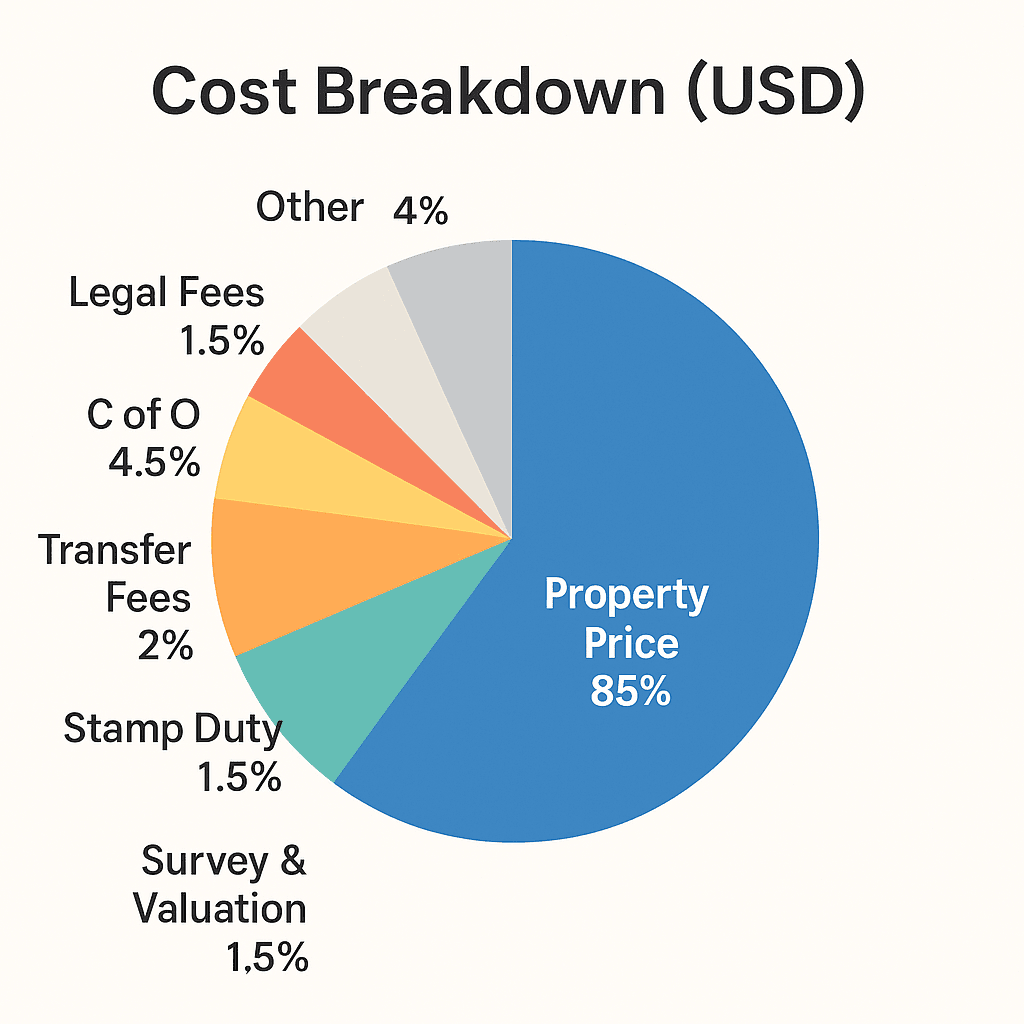
Mistake 3: Not Factoring in Hidden Costs
You budget $30,000 for property. But forget:
- Governor's consent: 15% of purchase price
- Legal fees: 5-10%
- Transfer fees: 2-3%
- Survey costs: $300-$500
Suddenly your $30,000 property costs $38,000.
Budget 30-40% above the property price for total costs.
Mistake 4: Using Retirement Funds Without a Plan
Borrowing from 401(k) or taking early withdrawal without understanding tax implications and repayment requirements.
If you can't repay, you'll pay taxes + 10% penalty on the withdrawn amount.
Only use retirement funds if you have a concrete repayment plan.
Final Thoughts: Choose Your Path
There's no single "best" way to finance Nigerian property from the US. Your choice depends on:
- Your savings
- Your income
- Your risk tolerance
- Your timeline
- Your US financial situation
Conservative path: Save cash, buy outright, no debt. Safe but slow.
Moderate path: Use home equity or personal loan to accelerate. Balanced risk/reward.
Aggressive path: Leverage US credit heavily to buy multiple Nigerian properties. High risk, high potential reward.
Know yourself. Choose accordingly.
And remember: Nigerian property should be part of your wealth-building strategy, not the entirety of it.
Diversify. Keep US investments. Keep emergency savings. Then use Nigerian real estate to multiply what you've already built.
Your $30,000 can go incredibly far in Nigeria. Just make sure you're financing it smartly.
Ready to explore properties that fit your budget? Browse our listings or book a consultation to discuss financing strategies for your situation.
Disclaimer: This article provides general information, not financial advice. Consult with licensed financial advisors, CPAs, and attorneys before making investment decisions.